

by Jillian LaCross
Petting a dog is good for the soul. For as long as we have coexisted, humans have recognized the value and impact of dogs on our lives. We feel better. We feel stronger. We know it without being able to explain why.
Now, we can. More or less. Modern science has been able to better quantify how beneficial a dog is for our physical and mental health through various studies. These benefits occur in therapy and service dog partnerships in particular, but there are physical and mental advantages for anyone who owns a dog, or even simply encounters a dog. This is supported by plenty of research from various institutions in the United States and around the world.
“Research has demonstrated a number of measurable physiological changes when people interact with dogs,” says Dr. Nancy Gee, Director, Center for Human-Animal Interaction, and Professor of Psychiatry and Bill Balaban Chair in Human-Animal Interaction at Virginia Commonwealth University. “These changes are commonly linked to relaxation in humans. For example, interacting with a dog has been shown to decreased blood pressure, heart rate, muscle tension, and cortisol (a stress hormone), while increasing heart rate variability (a measure of relaxation) and oxytocin (a feel good/bonding hormone). There are also psychological effects related to interacting with dogs. For example, depression, anxiety, agitation, aggression, and loneliness have been reduced and mood, empathy, social interactions, quality of life and physical activities like walking have been shown to increase.”
And it’s a two-way street. Studies performed on dogs have shown similar benefits because of the presence and touch of humans. “We’ve seen that when humans and dogs interact, both species experience an increase in their oxytocin levels and a decrease in their cortisol levels,” explains Dr. Gee. “This demonstrates that the bond between humans and dogs can be mutually beneficial. Now this doesn’t mean it is the case for every interaction. Usually, when researchers are studying these situations, the human and the dog are sitting together with the human stroking the dog and/or looking at them and/or talking to them.”
Talk about a match made in heaven.
Pets are Heart Healthy
Pets are good for your heart, in more ways than one. This is a good thing, as “cardiovascular disease (CVD) is the leading cause of death worldwide,” according to a study reported in Scientific Reports. Reducing and better managing stress, as Dr. Gee noted, has an effect on your heart health and function.
I asked Dr. Glenn Levine, Master Clinician and Professor of Medicine, Baylor College of Medicine Chief, Cardiology Section, Michael E. DeBakey VA Medical Center, and a committee chair for the American Heart Association, about whether pet ownership has an impact on human physiology. This question perfectly fit in with Dr. Levine’s experience, as he helped lead a committee that wrote a 2013 report about pet ownership for the American Heart Association, which included evaluation on how dog ownership is associated with influencing and reducing CVD.
The committee critically assessed data from several studies from around the world3 and were led to two conclusions, according to Dr. Levine: (1) Pet ownership, particularly dog ownership, is probably associated with decreased CVD risk. (2) Pet ownership, particularly dog ownership, may have some causal role in reducing CVD risk. “Pet ownership seemed to have a positive or beneficial impact on autonomic function and cardiovascular reactivity to stress,” explains Dr. Levine. “Pet owners seemed to have a little lower heart rate and blood pressure, and blunted increases to stress.”
Having a pet around could potentially influence human mortality as well. A 12-year study published in November 2017 in Scientific Reports. The study was large, comprised of 3.4 million Swedish adults ages 40 to 80. The study found that “dog owners were 31 percent less likely to die from a heart attack or stroke than those who don’t own dogs.”2 There is a correlation that dog owners generally get more exercise than non-dog owners, so increased physical activity, which is known to be good for your heart and muscles, may play a role. There’s also something to be said for companionship and warding off loneliness, which help to keep people active and engaged, potentially boosting longevity.
All of this doesn’t mean you should run to the nearest breeder or humane society to find a dog of your own. Dog ownership is a financial and personal commitment, one that takes careful decision making. Dogs aren’t “magic bullets,” if you will. Then again, “magic” might be the word used by many a dedicated dog owner.
Pets Reduce Stress
Think about a stressful day. Maybe something didn’t go well at work. Perhaps you’ve been sick, or a family member has needed a lot of extra care lately. Who do you want to see at the end of such a day? Probably your non-judgmental, loving, cozy Labrador, who is simply happy to have you home and content to be your companion. Just seeing your dog is enough to lift anybody’s mood. Petting your Lab offers even more benefits, as was found in Dr. Patricia Pendry’s study conducted on college students at Washington State University.
Dr. Pendry’s background perfectly suited her to this age group, and she became intrigued by answering an important question that plagues not just college students. “My training was very much emphasizing the kind of the physiological ramifications both of stress, particularly in childhood. To what extent does that get under the skin and alter some of our physiology? We know from decades of research that if you experience a lot of stress, either acute or chronic, you get dysregulation of hormone function, where you overproduce at a time when you don’t need it. You underproduce at the times when you do. We see weird patterns of dysregulation, particularly cortisol production, but other parts as well. The idea for me is, can we alter physiological function from dysregulation to more adaptive patterns, to then bring down mental health symptoms?”
Through a rigorous, multi-year study, Dr. Pendry and her team worked to isolate the difference petting an animal has on how the human body and mind handle stress. There were three groups: a group that got to pet a dog for 10 minutes; another group that observed other people petting animals while they waited their turn; and another group that watched a slideshow of those same animals and told they would interact with animals soon. The standard of measure was cortisol levels, samples of which were taken through oral swabs before and after the pet interaction.
“This study has gotten a lot of attention because it applied a very rigorous design to this implied idea that dogs reduce stress,” explains Dr. Pendry. “But this was the one that really demonstrated that while accounting for people’s own patterns. They took samples at home in the morning when they first woke up. Then at the beginning of the intervention, and then again after associated with ten minutes of petting. We did notice that the hands-on petting was what definitively and very significantly reduced the momentary levels of cortisol in the bloodstream. Even while controlling for that person’s normal pattern.”4
Dr. Pendry also wondered if the results would be similar in an unstructured drop-in program, working with Pet Partners (which provides therapy animal teams) on campus and allowing students to stop in when they wanted and stay as long as they wanted. “We found when first-year students come in [to college], we see a decline in mental health. The declines for the people who were assigned to the drop-in program were much less steep,” describes Dr. Pendry.
Though the drop-in program also had other variables that could help to reduce stress, such as human interaction with the handlers on-site, hanging out with friends, and taking a break from their studies, the dogs played an important role. All of the students recruited to the drop-in program had left pets behind when they went to school. For many students, the drop-in program was a way for them to get a feel of home, but for other students, the thought of being around another dog was too much to bear… it made them miss their own dogs too much. Still, for many students, “their mental health seemed to be somewhat protected by these activities.”
Pets Increase Life Expectancy
In an article “The Friend Who Keeps You Young,”1 available through the John Hopkins Medicine website, Jeremy Barron, M.D., medical director of the Beacham Center for Geriatric Medicine at Johns Hopkins, discusses how “research has shown that owning a pet provides an amazing array of health benefits.” This would include things such as lower blood pressure, boosted oxytocin, increased self esteem, and increased physical activity.
In fact, according to the article, certain higher risk groups reported better or enhanced health outcomes once paired with a service dog: “An astonishing 84 percent of post-traumatic stress disorder patients paired with a service dog reported a significant reduction in symptoms, and 40 percent were able to decrease their medications….” Time and time again, in our In Their Debt column, we see how Labs in various service and therapy roles transform lives and enhance their way of life.
A dog doesn’t need to be in a specialized role for human beings to feel the benefits. Caring for a pet gives owners a sense of purpose, plus pets help to open the door for interaction with other humans. Dog owners, for instance, tend to get along well with other dog owners and from there develop deeper human relationships. In addition, touching or petting a dog seems to help us better be in the moment and notice the splendor around us. “Petting and holding an animal allows you to appreciate the beauty of nature,” explains Barron. “It’s relaxing and transcendental.”
In addition to the physiological, there are psychological benefits from petting dogs. Dr. Gee recently published a book at this subject at the request of the American Psychiatric Association Publishers entitled The Role of Companion Animals in the Treatment of Mental Disorders. The book covers how companion animals can participate in treatments for people experiencing a wide range of psychological conditions including depression, PTSD, and dementia. “In short, we do have an accumulation of evidence suggesting that interacting with a dog can have a number of positive effects on different psychological measures,” says Dr. Gee.
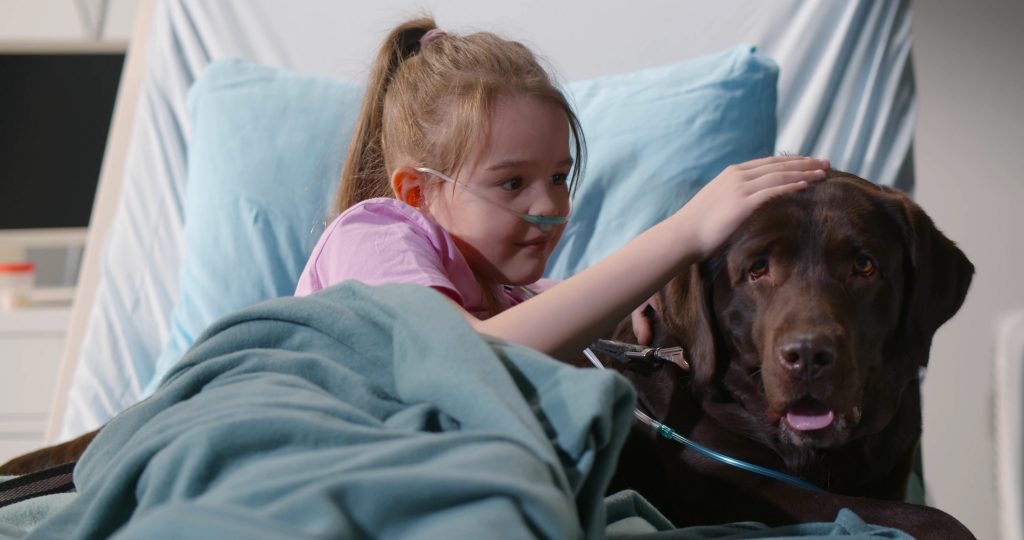
Dr. Gee’s own research is quite extensive. In her studies, “a common theme is that the most vulnerable people among us tend to experience larger positive effects of interacting with therapy dogs.” Dr. Gee continues, “This can be very inspiring to witness in person. I’ve seen children undergoing infusions for cancer treatment, who are sad and extremely uncomfortable, but when the dog walks into the room, their faces light up. Their parents smile and stand a little taller, breathe a little sigh of relief, and watch their child crawl onto the floor to sit beside the dog and stroke their fur. The healthcare workers observing the interaction stop and take a moment to absorb the positivity. Everyone just lives in that single moment, because that’s what dogs do, they live in the moment.”
Pets Help People Work Smarter – and Harder
A dog may not even need to be touched to have its magical effect. Presence may be enough. Presence may be enough to alter how we solved problems.
“I’ve been involved in research that examines aspects of human cognition in the presence of dogs over the years in a variety of populations; preschool children, eight-year-olds in England, college students in the US,” reports Dr. Gee. “In this work, I’ve seen that things like memory, categorization, executive functioning, and other aspects of cognition tend to be improved in the presence of a dog. I used to joke that dogs might just make us smarter, but the evidence seems to indicate that this may not actually be a joke.
“When we are around dogs we tend to relax and focus on the moment, this may allow our brains to function with greater efficiency and/or clarity,” Dr. Gee continues. “More work is needed on this topic, but by relaxing (lowering stress indicators such as blood pressure and cortisol), and eliminating off-topic thoughts (e.g., worry) we may in fact experience improved cognitive processing when we are interacting with a friendly dog. In other words, we may actually be smarter.”
Many companies, large and small, across the United States have policies in place that welcome pets, not just service animals. Big guys like Google and Amazon are among them. Multiple studies have found that dogs in the workplace help in multiple ways in order to have a more effective and efficient company – and a happier workforce.
In a study by Virginia Commonwealth University’s School of Business published in March 2012 in the International Journal of Workplace Health Management, researchers found that “dogs in the workplace can make a positive difference. The differences in perceived stress between days the dog was present and absent were significant. The employees as a whole had higher job satisfaction than industry norms.” The study took place at a business that employed 450 people, of which 20 to 30 pet owners were allowed to bring their dogs on site during the timeline of the study. Through self-reported surveys and voluntary saliva samples to track stress hormone levels, researchers saw a trend among employees who had their dogs present: their self-reported stress declined during the course of the day. Employees who did not have dogs present tended to have rising stress levels as the day went on.
As we all know too well, high stress at work can lead to burnout, dissatisfaction, and low morale. Having a pet around, especially your own, tends to help buffer a person’s mental health. Although the study didn’t specify whether the dogs were touched or not, it’s logical to assume that doting owners on the receiving end of a stressful get-it-all-done-now email would naturally reach for the comfort of their four-legged friends. Researchers of this study also overheard employee comments that were overwhelmingly positive to the dogs being around. Employees who didn’t have a dog at the office, both those who own pets and those who don’t, would find reasons to interact or help with the dogs – and overall, the general attitudes of employees were more positive as a result.
So, dogs can help reduce stress in the workplace as well as make us smarter. But there is a third major benefit. Dogs in the office tend to help employees collaborate and communicate better, as well as build friendships among coworkers. Pets are a natural ice breaker, invite conversation, and reduce isolation. As noted in the Harvard Business Review5, “ in one series of lab experiments, psychologists found that participants working on decision-making tasks in the company of a dog (versus a dog’s absence) rated their teams as more friendly and attentive, which increased their subsequent cooperation and interpersonal trust….welcoming pets can make the office a more social and inclusive place, key conditions to foster creative collaboration.”
A study by the American Pet Products Manufacturers Association supports this: “Employees at pet friendly workplaces are happier, less stressed, more creative, more co-operative with each other, and more productive at work.”
Does interaction with a dog need to be physical for all of these wonderful things to occur? All of our examples didn’t necessarily include physical contact. “Interestingly enough, research has shown both outcomes,” says Dr. Gee. “In some cases, petting or touching the dog has demonstrated beneficial effects relative to not touching the dog, and in other cases watching someone else interact with the dog, but not actively/currently touching the dog, has demonstrated beneficial effects.” More research is needed to be absolutely certain, yet it seems clear that any sort of interaction with a dog generally has a positive effect on human physiology and psychology. It also seems pronounced for dog owners in particular.
So if you want to lower your stress, lower your blood pressure, get in better shape, cooperate better with others the office, and live longer, you may not need to look any further than you lovable Lab.
Thank you to our researchers and experts for being a part of this article. Consider volunteering or supporting programs as found at Virginia Commonwealth University (https://chai.vcu.edu/dogs-on-call/joining-dogs-on-call/) near you.
1 “The Friend Who Keeps You Young.” Johns Hopkins Medicine. www.hopkinsmedicine.org/health/wellness-and-prevention/the-friend-who-keeps-you-young
2 “Dog ownership and the risk of cardiovascular disease and death – a nationwide cohort study.” November 17, 2017. Scientific Reports. https://www.nature.com/articles/s41598-017-16118-6
3 “Here’s more evidence your dog might lengthen your life.” American Heart Association News. October 8, 2019. www.heart.org/en/news/2019/10/08/heres-more-evidence-your-dog-might-lengthen-your-life
4 “Study demonstrates stress reduction benefits from petting dogs, cats.” WSU Insider, Washington State University. July 15, 2019. https://news.wsu.edu/press-release/2019/07/15/study-demonstrates-stress-reduction-benefits-petting-dogs-cats/
5 Harvard Business Review. “Research: The Benefits of a Pet-Friendly Workplace” by Shawn X. Quan and Kira Schabram. November 13, 2023. https://hbr.org/2023/11/research-the-benefits-of-a-pet-friendly-workplace